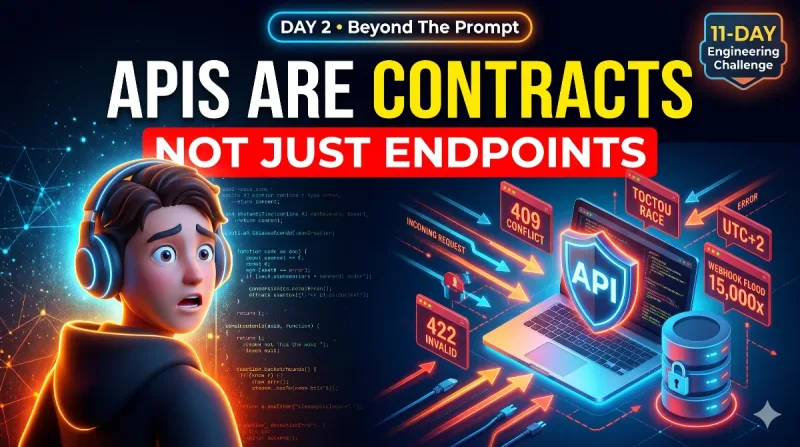
Day 2 — Your API Works Until Someone Sends Something You Didn't Expect
Part 2 of 11 in the Beyond the Prompt Series.
---
It is 3:42 PM on a Friday. Your calendar booking and scheduling SaaS has been live for four weeks. You built it by prompting AI to integrate Google Calendar, Stripe, and a database booking router. Everything functioned seamlessly during your local manual tests.
Then your sales team signs a multinational enterprise client based in Zurich, with satellite offices in London, Tokyo, and San Francisco. They initiate a bulk synchronization of 2,000 calendar appointments across their regional teams via your public REST API.
Within five minutes, three separate production incidents unfold simultaneously:
1. The Ghost Double-Bookings: Two executives in different timezones click "Reserve Boardroom" for the exact same conference room at the exact same millisecond. Your API returns a successful 200 OK response to both users. Both believe they secured the room, and both arrive with their clients.
2. The Zurich Daylight Shift: Timestamps originating from Switzerland arrive with an offset format (+02:00). Your backend strips the offset, parses the string through the server's default local time, and stores the meetings 24 hours in the past. Automated reminder emails fire instantly for meetings that supposedly occurred yesterday.
3. The Webhook Flood: Shopify sends a refund event webhook containing an emoji inside a customer note. Your unvalidated string parser throws an unhandled rejection, crashing the request without returning an HTTP status. Shopify's webhook engine assumes your endpoint is offline and re-delivers the webhook 15,000 times with exponential backoff, completely overwhelming your server.
You prompted AI for an API route that accepts appointments and handles webhooks. It worked when you tested with clean, polite inputs. It disintegrated when exposed to real-world entropy.
---
1. Technical Context: The Nature of Network Boundaries and Zero Trust
An API endpoint is not merely a JavaScript function attached to an HTTP URL. It is an immutable, distributed boundary separating two systems that cannot trust each other.
``
+-------------------------------------------------------------------------+
|                  THE API CONTRACT DISCONNECTION                         |
+-------------------------------------------------------------------------+
|  THE VIBE CODER MENTAL MODEL       |  THE PRODUCTION ADVERSARIAL MODEL  |
|  [Client]                          |  [Client / Bad Actor / Bot]        |
|     │                              |     │                              |
|     ├── (Sends clean JSON)         |     ├── (Sends 10MB payload)       |
|     ▼                              |     ├── (Sends concurrent clicks)  |
|  [Route Handler]                   |     ├── (Sends corrupted offsets)  |
|     │                              |     ▼                              |
|     └── db.insert(req.body)        |  [Boundary Validation Engine]      |
|                                    |     │                              |
|                                    |     └── (Enforces Atomic Lock)     |
+-------------------------------------------------------------------------+
`
When you build with an AI assistant, the model generates code under the implicit assumption of compliance: it assumes the caller will send valid data types, positive numbers, standard strings, and single sequential requests.

In reality, your API is exposed to the open internet. Browsers transmit numbers as strings (
"123" instead of 123), external bots probe for buffer vulnerabilities with multi-megabyte payloads, network routing variations deliver webhooks out of order, and concurrent users execute identical requests within microseconds of each other. A production API must operate on the principle of Zero Trust: every input must be strictly parsed at the network boundary, and all state mutations must be protected at the database engine level.
---
2. How the Failure Happens: Concurrency Collisions and Timezone Traps
Understanding the root cause of API failure requires looking beneath high-level application code into concurrency mechanics and international time standards.
The Time-of-Check to Time-of-Use (TOCTOU) Race Condition
When an AI generates an availability-checking endpoint, it almost universally adopts the check-then-act anti-pattern:
1. SELECT is_booked FROM slots WHERE id = 84
2. if (is_booked) return error
3. UPDATE slots SET is_booked = true WHERE id = 84
When two HTTP requests arrive within 15 milliseconds of each other, Request A reads the database and finds the slot available. Before Request A can execute the update, Request B reads the exact same row and also finds it available. Both requests pass the application check. Both execute the update. Both return 200 OK.
The fix cannot live in Node.js or Django memory because application worker processes are stateless and clustered. Concurrency guarantees must be enforced by the storage engine using Optimistic Concurrency Control (conditional updates) or Pessimistic Row Locking (select_for_update() in Django ORM or SELECT ... FOR UPDATE in SQL).
The Fallacy of Local Time
JavaScript's Date object is notoriously deceptive. When an ISO timestamp string without explicit timezone indicators is passed to new Date(), the runtime defaults to the host operating system's local clock. If your server is hosted in US East (UTC-5) and processes a timestamp intended for Central European Summer Time (UTC+2), direct date manipulation introduces an unrecoverable seven-hour distortion. Calculating offsets via manual integer addition (timestamp + 3600000) fails across Daylight Saving Time (DST) transitions, where days are 23 or 25 hours long.
---
3. Practical Use Cases & Architectural Comparison
Hardening an API requires moving from loose convention to rigid schema enforcement, semantic status codes, and atomic persistence.
The comparison below details how production systems handle external inputs compared to naive generated endpoints:
| Dimension | Naïve AI-Generated Endpoint | Production-Hardened Contract API |
| :--- | :--- | :--- |
| Input Parsing | Direct property access (req.body.id). | Strict schema validation with boundary rejection (e.g., Zod). |
| Concurrency | Read-then-write logic evaluated in memory. | Atomic conditional SQL (UPDATE ... WHERE status = 'OPEN'). |
| Time Storage | Arbitrary strings or local server timestamps. | Universal TIMESTAMPTZ in UTC with IANA timezone strings. |
| HTTP Semantics | Returns 200 OK with { error: "failed" }. | Granular semantics: 400, 401, 403, 409 Conflict, 422. |
| Webhook Ingestion | Parsed JSON verification. | Cryptographic HMAC validation against raw socket request buffers. |
| Async Operations | Floating background promises (sendEmail()). | Decoupled background job queues with guaranteed execution. |
Enforcing the Contract with Zod Schemas
Instead of manually writing dozens of fragile if (!req.body.email) checks, senior engineers construct an immutable boundary contract:
- The schema strips unrecognized fields (
.strict()), preventing attackers from injecting arbitrary properties into downstream models.
Strings are validated against ISO 8601 UTC formats.
Numeric values are constrained within acceptable operational boundaries (e.g., positive integers, maximum batch sizes).
If validation fails, the API immediately halts execution and returns an HTTP 422 Unprocessable Entity containing machine-readable error descriptors.
---
4. Limitations and Architectural Boundaries
While contract-first API design is critical, developers must recognize practical boundaries to avoid over-engineering:
1. Schema Validation Performance Overhead: Validating complex, deeply nested JSON objects on every single HTTP request consumes CPU cycles. For ultra-high-throughput streaming endpoints, lean binary protocols (Protocol Buffers, gRPC) or lightweight validators (TypeBox) outperform heavy reflection libraries.
2. Pessimistic Locking Contention: Using SELECT ... FOR UPDATE row locks eliminates race conditions, but locks hold database resources until the transaction completes. Under heavy write contention on a single popular record, requests queue up, driving up latency.
3. The Limits of Idempotency: Storing idempotency keys in a fast cache (Redis) guarantees deduplication across short windows (e.g., 24 hours), but cannot protect against duplicate requests submitted weeks apart without persistent transactional audit tables.
---
5. Strategic Implications for Engineering Teams and Founders
The architectural discipline applied to your APIs dictates the operational stability of your commercial integrations:
- Customer Trust and Chargebacks: Double-booking resources or double-charging cards destroys customer trust instantly. Fixing a single financial race condition after the fact requires database surgery, customer support intervention, and gateway dispute fees.
- Third-Party Integration Health: Payment gateways and enterprise platforms automatically disable webhooks if your endpoint fails to acknowledge events within strict timeout windows (typically 5 seconds). Brittle parsing directly threatens business continuity.
- Frontend-Backend Decoupling: When APIs return precise HTTP status codes (
409 Conflict, 422 Unprocessable), client applications can render deterministic, helpful user experiences rather than generic crash screens.
---
6. What Next: The Day 2 Action Plan
Audit your public and internal API endpoints today using this prioritized checklist:
1. Verify Webhook Signatures on Raw Buffers: Ensure your payment and integration webhooks verify HMAC signatures against the raw binary request buffer before body-parser converts it to JSON.
2. Eliminate Read-Modify-Write Cycles: Search your controllers for instances where code checks a record's status in one query and updates it in another. Replace them with single atomic conditional statements.
3. Audit Database Timezone Columns: Verify that all timestamp columns across your PostgreSQL or MySQL databases are typed as TIMESTAMPTZ (UTC), and ensure your application captures the user's regional IANA timezone identifier (Europe/Zurich) separately.
---
Frequently Asked Questions (FAQs)
What is the difference between a race condition and a deadlock?
A race condition occurs when the outcome of a process depends on the uncontrollable order or timing of concurrent execution threads, often resulting in corrupted state. A deadlock occurs when two or more concurrent processes are unable to proceed because each is waiting for the other to release a shared resource or lock.
Why is returning HTTP 200 with an error object considered an anti-pattern?
Returning an HTTP 200 OK status for a failed request violates HTTP protocol standards. It misleads API gateways, caching proxies, and automated client libraries into treating the request as successful, breaking automatic retry logic and corrupting client-side error telemetry.
Why must webhooks be validated using the raw request body?
Webhook signatures are cryptographic hashes calculated across the exact byte sequence of the original transmission. If your web framework parses the JSON payload first, key ordering, spacing, and character escapes may alter slightly, causing the hash verification to fail even though the payload is authentic.
What is the advantage of IANA timezones over numerical UTC offsets?
Numerical offsets (such as +02:00) only capture a fixed difference from UTC at a single moment. IANA timezone identifiers (such as Europe/Zurich or America/New_York`) represent geographic regions and incorporate all historical, current, and legislated future Daylight Saving Time transition rules.
How do idempotency keys prevent duplicate payments?
An idempotency key is a unique identifier generated by the client for a specific operation. When the server processes a request with an idempotency key, it records the key and the resulting response. If a subsequent request arrives with the exact same key (e.g., due to a network retry), the server returns the saved response without executing the operation a second time.
---
Conclusion
An API is not just a mechanism to connect a React interface to a backend database. It is an immutable contract designed to withstand an uncoordinated, adversarial internet.
When your API assumes good actors, polite inputs, and single-threaded execution, it is an experiment. When it enforces strict boundary validation, handles timezones immutably, and guarantees concurrency safety at the storage layer, it becomes production engineering.
👉 Continue to Day 3 — Databases Are Not Spreadsheets: Your App Has a Database. But Does It Have a Database Strategy?
---
Sources & References
RFC 9110 — HTTP Semantics: Fielding, R., Ed., Nottingham, M., Ed., & Reschke, J., Ed. (Published by IETF, 2022). HTTP Status Codes and Method Properties*. datatracker.ietf.org/doc/html/rfc9110
Zod Documentation & Schema Validation Architecture: Colina, C. (Updated 2024). Type-Safe Schema Declaration for TypeScript*. zod.dev
Stripe Developer Guides on Webhook Security: Stripe Engineering. (Updated 2024). Verify Webhook Signatures and Handle Duplicate Events*. docs.stripe.com/webhooks
Martin Kleppmann on Concurrency: Kleppmann, M. (2017). Designing Data-Intensive Applications: The Big Ideas Behind Reliable, Scalable, and Maintainable Systems*. O'Reilly Media. dataintensive.net