Imagine a typical day in the life of a software engineer: you start your morning by crushing tickets, writing hundreds of lines of clean code, closing complex pull requests, and pushing updates to production. By all metrics, you are incredibly productive.
But here is the critical question: Does this high volume of work actually translate to real user satisfaction or business success?
In a recent video from the How to be an effective SWE series on the Google for Developers channel, engineering leader Addy Osmani tackles this exact question. He explores the subtle but profound distinction between efficiency and effectiveness—and why shifting your mindset from outputs to outcomes is the key to transforming your impact and accelerating your career.
---
Efficiency vs. Effectiveness: The Core Distinction
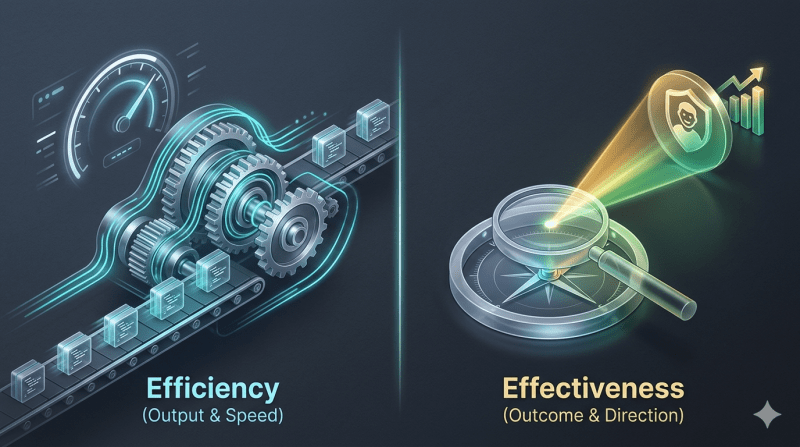
At their core, efficiency and effectiveness are two sides of the same coin, but they address entirely different dimensions of work:
Efficiency is about doing things right. It focuses on velocity, optimization, code quality, test coverage, and development speed. It is centered on the how*.
Effectiveness is about doing the right things. It focuses on value creation, alignment, problem-solving, and building systems that actually address real-world needs. It is centered on the what and why*.
An engineer can be highly efficient—shipping code at lightning speed—while remaining completely ineffective if they are building the wrong features. Conversely, an engineer who identifies the exact root cause of a system issue and resolves it with a simple, three-line configuration change is highly effective, even if their code output for the day was minimal.
Head-to-Head Comparison
| Metric | Efficiency | Effectiveness |
| :--- | :--- | :--- |
| Primary Focus | Output (velocity, tickets, lines of code) | Outcome (user satisfaction, business value) |
| Core Question | "Are we building this fast, clean, and optimally?" | "Are we building the right thing to solve the problem?" |
| Core Driver | GPU / CPU compute, tooling, process optimization | User empathy, strategic alignment, system judgment |
| Primary Goal | Minimize resource waste and accelerate execution | Maximize value and long-term organizational impact |
| Typical Trap | Shifting into a "feature factory" without direction | Analysis paralysis or slow delivery speed |
---
Shifting Focus: Outcomes Over Outputs
A major theme in Osmani's teaching is the transition from outputs to outcomes.
- Outputs are the tangible results of your activities. Examples include shipping a new feature, writing a refactoring script, or closing a Jira ticket.
- Outcomes are the actual, measurable changes in user behavior or business performance that result from those outputs. Examples include a 20% reduction in customer onboarding time, a drop in user churn, or an increase in daily active users.
When engineering teams focus solely on outputs, they risk falling into the "feature factory" trap—constantly shipping code without ever measuring whether it solved a problem. By aligning technical efforts with desired outcomes, engineers gain the flexibility to find the most elegant, simple solutions to problems. Sometimes, the most effective way to achieve an outcome is to write no code at all.
---
Effectiveness Across Career Stages
The definition of effectiveness is not static; it evolves as you grow from an early-career developer into a senior leader.
1. Early Career (Fundamentals & Quality)
In the early stages of a software engineering career, effectiveness is built on a foundation of technical execution. It involves:
- Mastering your tools and development environment.
- Writing clean, maintainable, and well-tested code.
- Developing a strong quality mindset and delivering reliable work.
- Learning to collaborate and communicate effectively within a team context.
2. Growth & Seniority (From "Me" to "We")
As you transition to senior and lead roles, individual technical productivity becomes a baseline. True seniority is about scaling your impact by moving from a "me" mindset to a "we" mindset:
- Mentorship: Fostering the growth of junior engineers and sharing knowledge.
- Systems Judgment: Navigating complex architectural trade-offs and anticipating long-term maintenance costs.
- Cross-Functional Influence: Collaborating with product managers, designers, and business stakeholders to ensure engineering goals align with business goals.
3. The AI Era
The rise of AI-assisted development tools (like code generation models and agentic coding assistants) makes this career evolution even more urgent. AI tools excel at optimizing the "how"—generating boilerplate, writing unit tests, and automating routine debugging.
By taking over these high-efficiency tasks, AI elevates the value of human-centric effectiveness skills:
- Deep architectural judgment and system design.
- Empathy for user needs and customer pain points.
- Strategic alignment and complex decision-making.
In the AI era, the most successful engineers are those who leverage AI to handle efficiency, freeing up their own cognitive bandwidth to focus on effectiveness.
---
Key Traits of Highly Effective Engineers
What qualities define an effective engineer? Osmani highlights several key traits:
1. User Empathy: They don't just write code for the sake of technology; they build with a deep understanding of the customer's pain points and goals.
2. Focus on Simplicity: They resist the urge to write overly clever or complex code. They prioritize readability and maintainability, recognizing that unnecessary complexity is a long-term debt the entire team must pay.
3. Strong Communication: They communicate technical ideas clearly to both technical and non-technical audiences, listen actively, and share information transparently to build trust.
4. Strategic Alignment: They align their daily tasks with the broader team and company strategy. This allows them to operate with high autonomy and make decisions independently.
5. Problem-Solving & Reliability: They are dependable team members who look beyond immediate bugs to find the root causes of issues, delivering robust solutions that empower the whole team.
---
The Environment's Impact on Team Effectiveness
Individual effectiveness cannot thrive in a toxic or dysfunctional environment. Engineering effectiveness is deeply connected to team culture.
Google's famous study on team performance, Project Aristotle, revealed that psychological safety is the single most important dynamic of high-performing teams. In a psychologically safe environment:
- Team members feel safe to take calculated risks.
- Engineers can ask questions or admit mistakes without fear of embarrassment or retribution.
- Diverse perspectives are welcomed, fostering innovation and better problem-solving.
To cultivate this environment, Osmani outlines a leadership framework centered on three pillars:
- Enable: Remove blockers, streamline processes, and provide the necessary tools and resources.
- Empower: Trust engineers with autonomy, encourage ownership, and avoid micromanagement.
- Expand: Invest in the team's long-term growth through mentorship, career development, and strategic opportunities.
---
Conclusion: Transform Your Impact
Transitioning from a good engineer to an effective one is a journey of shifting your perspective. While technical efficiency remains a crucial foundation, true impact is driven by effectiveness.
The next time you open your IDE or pick up a ticket, take a step back and ask:
1. Why are we building this feature?
2. What user or business outcome are we trying to achieve?
3. Is there a simpler, more maintainable way to solve this problem?
By constantly aligning your technical skills with real-world outcomes, you will not only write better software but also drive meaningful, lasting value.
---
FAQs
What is the simplest way to start practicing effectiveness as an individual contributor?
Start by asking "why." Before diving into coding a new feature or task, clarify the intended user or business outcome with your product manager or team lead. Understanding the goal often reveals simpler, more efficient paths to the same result.
Can an engineer be too focused on effectiveness at the expense of efficiency?
Yes. If you focus exclusively on finding the perfect high-impact solution, you can fall into analysis paralysis, delaying shipping and learning from actual user feedback. A balance is necessary: use effectiveness to choose the right path, and efficiency to deliver on that path cleanly and quickly.
How do engineering managers measure effectiveness instead of just efficiency?
Effective managers look beyond velocity metrics (like pull requests closed or lines of code). They measure effectiveness through outcomes (e.g., successful product launches, system reliability, resolved customer issues), team health (psychological safety, low burn-out), and how well engineering goals align with business objectives.
How does AI change the balance between efficiency and effectiveness?
AI tools accelerate efficiency by automating repetitive tasks (code completion, test generation, syntax fixes). This shifts the engineer's primary value contribution toward effectiveness—focusing on architectural design, domain modeling, user safety, and aligning technical solutions with business strategy.