NVIDIA’s Nemotron-Labs-Sigma Brings Continuous Diffusion to Open Language Models
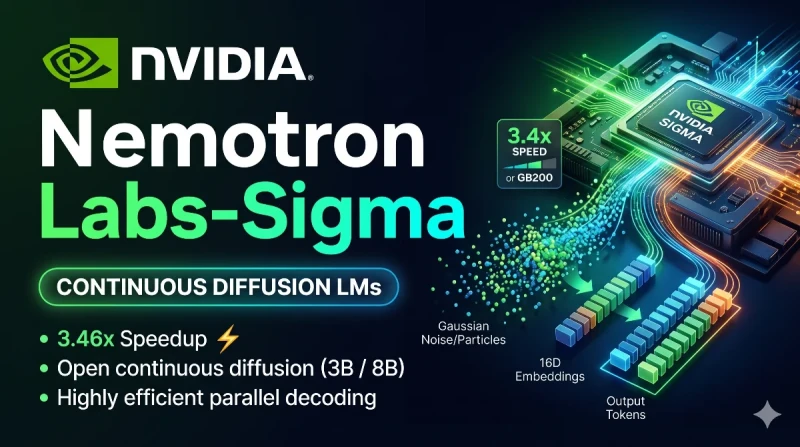
NVIDIA has released Nemotron-Labs-Sigma, a family of open-weight continuous diffusion language models at 3B and 8B scales, along with 14 checkpoints spanning base, instruct, few-step distilled, and self-speculative variants. Unlike the dominant autoregressive approach or discrete diffusion language models, Sigma generates text by iteratively denoising compact continuous token embeddings in a learned 16-dimensional space, producing blocks of tokens in parallel.
The release, with weights on Hugging Face and a detailed technical paper (arXiv:2610.02665), gives developers a practical new paradigm for parallel decoding, inference-time steering, and efficient generation. It arrives as frontier labs continue refining autoregressive models while open research explores alternatives that can improve throughput without sacrificing competitive reasoning and coding performance.
How Continuous Diffusion Language Models Work
Standard large language models generate one token at a time left-to-right. Discrete diffusion language models (such as LLaDA-style approaches) operate over discrete tokens but face challenges with non-smooth high-dimensional spaces that limit trajectory steering and efficient few-step sampling.
Sigma instead works in a smooth, low-dimensional continuous embedding space. The model jointly learns the token embedding geometry and a denoiser. At inference, it initializes a block of positions with Gaussian noise, then iteratively denoises the 16-dimensional embeddings conditioned on the preceding context. A readout head maps the cleaned embeddings to discrete tokens. The process repeats block by block.
Key technical elements include:
- Shared backbone supporting both an autoregressive stream (clean tokens) and a diffusion stream.
- Warm-starting from pretrained autoregressive weights.
- Classifier-free guidance and score temperature for controlling quality-diversity trade-offs.
- Self-conditioning that reuses prior conditional predictions.
- Block-wise training via likelihood optimization.
The NVIDIA research page and paper emphasize that the smooth ODE/SDE trajectories enable practical few-step distillation and embedding-space steering—capabilities harder to achieve in discrete diffusion setups.
Speed and Efficiency Claims
NVIDIA reports substantial throughput gains relative to pure autoregressive decoding:
- Distilled models achieve roughly 8 tokens per forward pass on math and 4 on coding with negligible accuracy loss and preserved diversity (via distribution matching distillation).
- Self-speculative decoding on the 8B model yields an average 3.46× throughput speedup over autoregressive decoding on an NVIDIA GB200, with the distilled diffusion path drafting blocks that the autoregressive stream verifies.
Independent coverage notes peak reported speedups around 4.2× at 8B and 3.18× at 3B in certain configurations. These numbers come from NVIDIA’s evaluations; real-world results will vary with hardware, batch size, sequence length, and the exact sampling schedule (DDPM or DDIM, number of function evaluations).
Benchmark Performance on Coding and Reasoning
According to the paper and model cards, Sigma is competitive with leading masked discrete diffusion models and autoregressive baselines after pretraining on standard benchmarks such as GSM8K, Minerva, HumanEval, and MBPP. After supervised fine-tuning it shows strong results on harder tasks including MATH-500 and AIME, with particularly consistent gains on coding.
The research page highlights superior performance on code completion relative to matched baselines. Base models are not instruction-tuned; developers should use few-shot or benchmark-style prompting, or switch to the instruct variants for conversational use. Context length is 4,096 tokens for most variants (8,192 for the 8B instruct model).
These are vendor-reported results. Independent third-party leaderboards have not yet extensively ranked the Sigma family, so developers should treat the numbers as directional and run their own evaluations on target workloads.
Available Checkpoints and How to Use Them
All 14 checkpoints are available on Hugging Face under the NVIDIA Nemotron Open Model License, which permits commercial and non-commercial use. Variants include:
- Base and instruct models at 3B and 8B.
- Few-step distilled students at different NFE levels (2, 4, 8, 16).
- Self-speculative decoding variants.
Loading requires trust_remote_code=True because the custom modeling code ships with the weights. Inference needs an NVIDIA GPU in bfloat16 (Ampere, Lovelace, Hopper, or Blackwell). CPU inference is not supported, and no quantized variants are listed in the initial release. Approximate throughput on a single H100 is cited in the 120–140 tokens/s range for certain configurations.
Minimal loading pattern (from model cards):
``python
from transformers import AutoTokenizer, AutoModel
repo = "nvidia/Nemotron-Labs-Sigma-8B" # or 3B / instruct variants
tokenizer = AutoTokenizer.from_pretrained(repo, trust_remote_code=True)
model = AutoModel.from_pretrained(repo, trust_remote_code=True)
model = model.cuda().to(torch.bfloat16).eval()
``
Developers will need to consult the accompanying modeling code and research page for generation loops, guidance parameters, and block size handling.
Practical Developer Use Cases
Sigma is most relevant for:
- Research on alternative generation paradigms — Studying continuous diffusion, trajectory steering, and few-step sampling for text.
- High-throughput coding assistance — Parallel block decoding and strong code completion results make it interesting for offline or batch code generation, completion, and refactoring pipelines.
- Efficient local inference — Open weights allow self-hosting; the 3B variants are more accessible on smaller GPUs.
- Speculative decoding experiments — The built-in self-speculative path provides a ready-made drafter-verifier setup.
- Custom fine-tuning or distillation — Base checkpoints serve as starting points for domain-specific work.
It is less suited today for production tool-calling agents, very long-context work, or CPU/edge deployment.
Limitations and Caveats
- Base models lack instruction tuning and tool calling.
- Context windows are modest compared with current frontier autoregressive models (which commonly offer 1M+ tokens).
- Inference is NVIDIA-GPU-only in bfloat16.
- Performance depends heavily on the number of denoising steps; fewer steps trade quality for speed.
- Independent evaluation coverage is still limited.
- Like all language models, it can produce inaccurate or undesirable outputs.
The model cards explicitly note these constraints and recommend appropriate use cases.
Industry Implications and What Happens Next
Continuous diffusion language models at this scale demonstrate that non-autoregressive approaches can remain competitive on coding and reasoning while unlocking structural advantages for parallel generation and inference-time control. If the speedups hold under broader testing, they could influence serving stacks, speculative decoding research, and future hybrid architectures.
Expect follow-on work in:
- Longer context extensions.
- Quantization and broader hardware support.
- Integration into popular inference frameworks.
- Community fine-tunes and independent benchmarks.
- Hybrid systems that combine continuous diffusion drafting with strong autoregressive verification.
NVIDIA’s open release lowers the barrier for researchers and developers to experiment with the approach rather than treating it as a closed research result.
FAQ
What is Nemotron-Labs-Sigma?
It is NVIDIA’s family of open continuous diffusion language models (3B and 8B) that generate text by denoising 16-dimensional continuous token embeddings in blocks rather than predicting one token at a time.
How does continuous diffusion differ from discrete diffusion or autoregressive models?
Autoregressive models emit tokens sequentially. Discrete diffusion models work over discrete tokens. Sigma operates in a smooth low-dimensional continuous embedding space, enabling easier trajectory steering and efficient few-step sampling.
What are the reported speedups?
NVIDIA reports roughly 8× acceleration on math and 4× on coding with few-step distilled models, plus a 3.46× average self-speculative decoding speedup for the 8B model on GB200. Results depend on configuration.
Can I use Nemotron-Labs-Sigma commercially?
Yes. The checkpoints are released under the NVIDIA Nemotron Open Model License, which allows commercial use. Inference requires an NVIDIA GPU.
Does it support tool calling or long context?
No. The released models do not perform tool calling, and context lengths are 4,096 tokens (8,192 for the 8B instruct variant).
Where can I download the weights?
All 14 checkpoints are available on Hugging Face under the nvidia/Nemotron-Labs-Sigma collection. The accompanying paper is on arXiv (2610.02665).
Conclusion
Nemotron-Labs-Sigma is a concrete, open demonstration that continuous diffusion can scale to multi-billion-parameter language models while remaining competitive on coding and reasoning and offering measurable generation efficiency advantages. For developers and researchers exploring alternatives to pure autoregressive generation, the combination of open weights, documented speedups, and a clear technical paper makes it one of the more actionable recent releases. Running independent evaluations on real workloads will determine how widely the approach is adopted, but the door is now open.
Sources
- NVIDIA Research page: Nemotron-Labs-Sigma (research.nvidia.com/labs/genair/sigma/)
- arXiv paper: Large Language Continuous Diffusion Models (arXiv:2610.02665)
- Hugging Face model cards (nvidia/Nemotron-Labs-Sigma-3B, nvidia/Nemotron-Labs-Sigma-8B and related checkpoints)
- MarkTechPost coverage of the release (November 20, 2026)
- Model card explainability documentation on Hugging Face