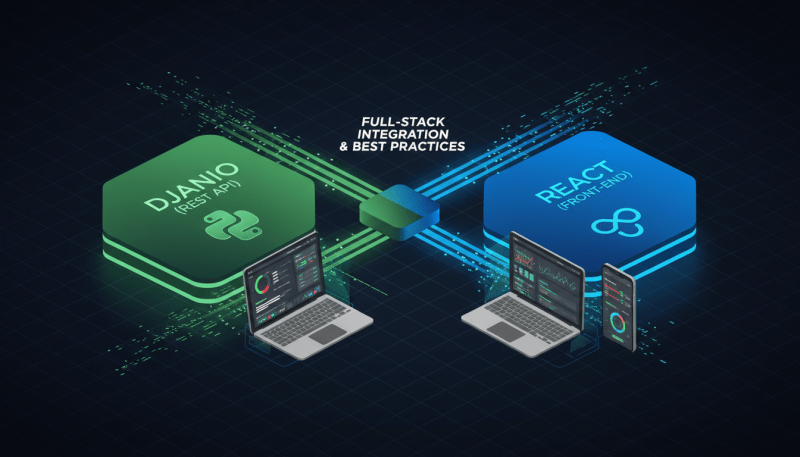
Integrating Django and React: Architecture and Best Practices
Building web applications with Django and React involves combining two distinct software design paradigms. Django acts as a robust, secure, and structured backend framework, while React serves as an interactive, component-based frontend library.
This guide outlines the architectural patterns, setup configurations, and best practices required to build and maintain an API-driven application using these technologies.
---
Project Structure and Setup
When integrating Django and React, developers typically choose between a decoupled architecture or a hybrid (monolithic) structure. A decoupled architecture is widely preferred for production environments as it separates concerns and allows for independent scaling.
``
project-root/
│
├── backend/            # Django Project
│   ├── manage.py
│   ├── myproject/
│   └── api/
│
└── frontend/           # React Application (Vite/Next.js)
    ├── package.json
    ├── src/
    └── vite.config.js
`
Key Setup Considerations:

1. CORS Configuration: Because the frontend and backend run on different origins during development (e.g.,
localhost:5173 and localhost:8000), you must configure Cross-Origin Resource Sharing (CORS). In Django, this is managed using the django-cors-headers package.
2. Environment Variables: Keep configuration separate from code. Use Django settings with django-environ for backend variables, and .env files prefixed with VITE_ or REACT_APP_ for frontend configuration.
3. Decoupled Deployment: Deploy the React frontend to static hosting platforms or Content Delivery Networks (CDNs) like Vercel, Netlify, or AWS S3, and host the Django backend on services like AWS, Heroku, or Render.
---
API Design and Integration
The communication between React and Django is established via HTTP requests. Building structured, consistent API endpoints is essential for maintaining frontend stability.
- Standardized REST Endpoints: Use Django REST Framework (DRF) or Django Ninja to build consistent, predictable endpoints. Follow RESTful conventions:
GET /api/articles/ (List articles)
POST /api/articles/ (Create an article)
GET /api/articles// (Retrieve an article)
PUT or PATCH /api/articles// (Update an article)
DELETE /api/articles// (Delete an article)
Status Codes: Ensure the API returns accurate HTTP status codes (e.g., 201 Created for successful POSTs, 400 Bad Request for validation errors, and 403 Forbidden for authorization failures).
Server-Side Pagination: Never transfer entire database tables. Implement cursor-based or limit-offset pagination in Django to limit payload sizes.
---
Django Backend Best Practices
To keep the backend secure, performant, and maintainable, implement the following patterns:
1. Explicit Data Serialization and Validation
Use DRF serializers to validate incoming client data and format outgoing database queries into JSON. Avoid performing business logic inside view functions; delegate this logic to models, serializers, or service layers.
2. Query Optimization
To prevent performance degradation (specifically the $N+1$ query problem), optimize database queries inside your views using select_related for foreign key relationships and prefetch_related for many-to-many relationships.
`python
Correct approach: Pre-fetching related data to minimize database hits
class ArticleViewSet(viewsets.ModelViewSet):
queryset = Article.objects.select_related('author').prefetch_related('tags').all()
serializer_class = ArticleSerializer
`
3. Stateless Authentication

Instead of relying on standard Django session cookies—which can introduce cross-site request forgery (CSRF) complexities in decoupled setups—use token-based authentication. JSON Web Tokens (JWT) via
djangorestframework-simplejwt are standard for securing stateless REST APIs.
---
React Frontend Architecture
A scalable React frontend is structured to handle asynchronous server state and local client UI state separately.
1. Server State vs. Client State
- Server State (API Data): Avoid fetching data inside raw
useEffect hooks, which can lead to race conditions and caching issues. Instead, use asynchronous data-fetching libraries like TanStack Query (React Query) or RTK Query. These manage caching, background updates, loading states, and error handling automatically.
Client State (UI State): Use lightweight state management libraries like Zustand or Jotai (or React's built-in Context API for simple configurations) to manage local UI state, such as dark mode toggles or sidebar states.
2. Component Organization
Structure the React application cleanly to promote reusability:
`
src/
├── assets/          # Static files (images, fonts)
├── components/      # Reusable UI elements (Buttons, Inputs)
├── features/        # Feature-based folders containing specific views, hooks, and tests
├── hooks/           # Shared custom React hooks
└── services/        # API client configurations (Axios/Fetch wrappers)
`
3. Type Safety
Integrating TypeScript into your React build ensures that frontend interfaces match the data structures returned by Django serializers, catching potential integration errors during development.
---
Testing Strategies
Maintaining stability across full-stack applications requires testing both components of the system.
- Backend Unit and Integration Testing: Test Django views, serializers, and models using Django's built-in
APITestCase or pytest-django`. Verify that endpoints enforce permissions, validate inputs, and return correct payloads.
Frontend Component Testing: Test React UI components, utility functions, and custom hooks using Vitest (or Jest) paired with React Testing Library.
End-to-End (E2E) Testing: Write high-level tests using Playwright or Cypress to simulate actual user workflows, confirming that frontend interactions trigger the expected data persistence on the Django backend.
---
Conclusion
Integrating Django and React combines the backend security and robustness of Python with the user experience capabilities of modern React. Success with this architecture relies on clear API contracts, strict data validation at the serializer level, optimized database queries, and a modern frontend state-management strategy. By decoupling the architecture, developers gain flexibility in deployment, scaling, and technology choices as the system evolves.